
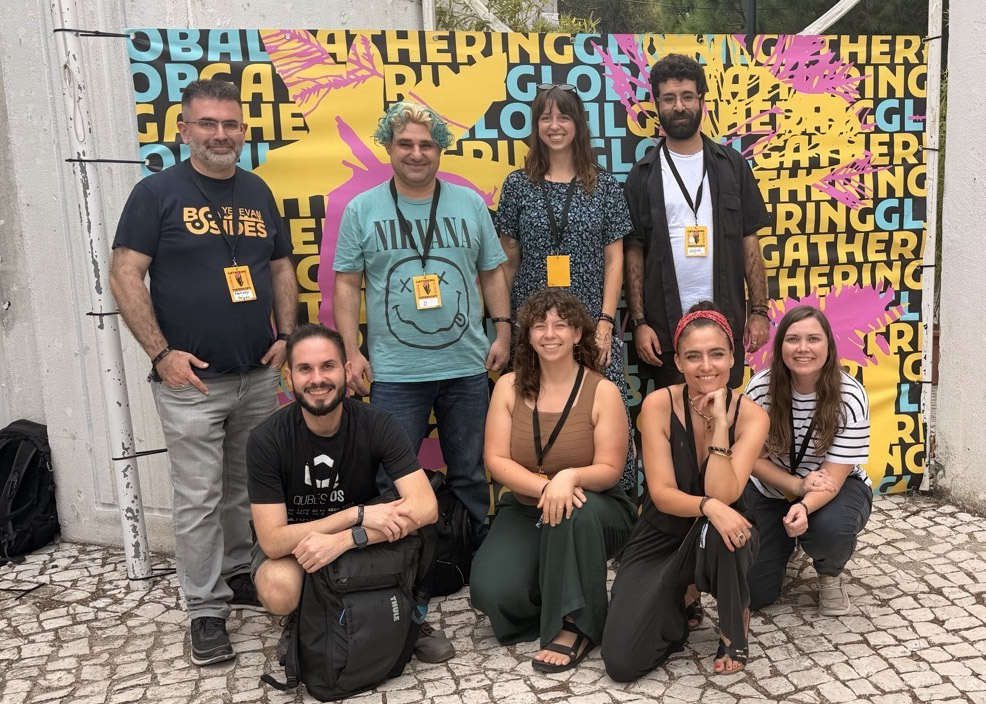
In 2011, the climate campaigner and security researcher Chris Abbott founded Open Briefing from his spare room in Cornwall, at the south-western tip of Britain. Far from the roundtables, policy briefings, and media interviews of London, he had space to reflect on what civil society needed to thrive.
Chris recalls: “Our Big Idea at the time was to help nonprofits and foundations achieve social change by supporting their campaigns and decision-making with intelligence and investigations.” He built a volunteer team of former intelligence, government, and media professionals who wanted to put their skills to work for social change.
Fifteen years on, Open Briefing looks very different. What began with one person’s vision has grown into an international team of more than 50 staff and consultants working across protection and security, digital risk and resilience, and wellbeing and collective care.
FROM INVESTIGATIONS TO COLLECTIVE PROTECTION
Understanding and assessing strategic risk was an important part of our early work. But our role soon began to expand. As Chris explains: “Because of the team we had and the trust we’d earned, we kept getting asked about practical safety and security challenges.” In 2016, Open Briefing shifted its focus towards security risk management. At the same time we rebuilt our team around those with both protection expertise and backgrounds in social justice, humanitarian aid, and environmentalism.
As our work expanded, we embraced the holistic security approach and brought in new consultants across digital security in 2017 and wellbeing and psychosocial support in 2018.
Dan Williamson joined as a protection and security consultant in 2017. A former aid worker and global security manager, he was drawn to Open Briefing’s agility and values. As he recalls, he liked the fact that it was “not a massive NGO machine”.
For Dan, one of the things that has stayed with him is the importance of “speaking truth to power” – being prepared to challenge partners when their approaches might increase risk, rather than simply agreeing with what was requested.
Dan’s understanding of protection has also evolved through working with defenders, reflecting a wider shift in Open Briefing’s approach. A security plan might address someone’s immediate risks, but what happens when threats extend to their family, colleagues or community? Or when digital surveillance, physical safety and psychological wellbeing are all affected by the same incident?
These questions have helped shape our increasingly holistic approach, bringing together different areas of expertise and recognising the importance of collective protection.
BUILDING A TEAM OVER TIME
In 2020, in the middle of the COVID-19 pandemic, Rosa Levin was made redundant. With a new baby at home, she found an unexpected opportunity to volunteer her financial management skills. A recommendation from a friend in the United States led her to Open Briefing, where she discovered that Chris was based just a few miles from her home in Cornwall.
Their first meeting – over Zoom, of course – was intended as an introductory interview but quickly turned into a to-do list. Chris needed help with financial planning, grant management, and project management, and Rosa soon found herself involved in all three.
“More than six years later my to-do list isn’t much different but the numbers have grown exponentially; the team, the partners, the grants!” she reflects.
Myo Min Oo’s journey to Open Briefing was very different. Having worked to establish internet networks in rural Myanmar, he had seen infrastructure he helped build destroyed by airstrikes and had been forced to flee the country.
When he joined Open Briefing as a digital risk and resilience consultant, what struck him was not only the expertise of his new colleagues, but their concern for his wellbeing.
“The organisation genuinely cared about the wellbeing of the people doing the work, not just the work itself.”
DIFFERENT PERSPECTIVES, STRONGER PROTECTION
For Myo, working alongside colleagues from different disciplines has changed how he approaches digital security.
An encrypted messaging application may improve security but attract unwanted attention at a checkpoint. A technically sound procedure may be impossible for an exhausted organisation to maintain. Advice that works in one context may create new risks in another.
“The international nature of the team helps us challenge assumptions, learn from different contexts, and make our recommendations more realistic.”
That collaboration was evident at a gathering of environmental human rights lawyers in Bangkok, where Myo worked alongside fellow exile Khine Myint Oo (Agnes), a trauma counsellor in Open Briefing’s wellbeing and collective care team.
Conversations that began with digital security questions sometimes revealed wider concerns about personal safety, organisational pressures, and stress, highlighting the value of bringing different areas of expertise together.
For Agnes, the experience reflected something that had initially attracted her to Open Briefing:
“What stood out to me was how different areas of expertise could come together to support the whole person, recognising the connections between protection, digital security, and wellbeing.”
Collaboration also depends on being able to connect across languages and distances. When Dan joined in 2017, the team worked predominantly in English with “a little bit of French around the sides”. Today, English, Spanish, Portuguese, French, and Arabic are among the languages at the heart of Open Briefing’s work, alongside many others.
Advances in technology have also opened up new possibilities for remote support. Dan recalls a recent call with a defender in rural Kalimantan, on the Indonesian side of Borneo, using a Starlink satellite internet connection and online simultaneous translation. Despite the remote location, the internet connection was excellent.
“That is just a game changer,” he said. “It felt brilliant.”
Technology has also made our work more complex. Beyond the more obvious abuse of surveillance and censorship technologies by governments and corporations, our recent work alongside quilombola communities in Brazil found drones being used against communities. As Carla Vitória, Open Briefing’s response coordinator, explained: “Drones dropping pesticides on their crops are a clear example of technology being used to facilitate violence against these communities.”
LEARNING FROM THE PEOPLE WE WORK ALONGSIDE
Myo’s experiences in Myanmar have shaped his understanding of the gap between security advice and the realities of working in conflict-affected environments. As he puts it, “what looks secure on paper might be completely impractical or even dangerous in the field.”
Working with organisations facing unreliable connectivity, limited resources and significant threats has deepened his appreciation for the knowledge defenders already hold.
“One thing that constantly surprises me is how resourceful defenders are.”
For Myo, the challenge is to understand how people already navigate risks, then find solutions they can realistically use.
Renata Oliveira, acting deputy director of protection and security, came to this work through human rights law and strategic litigation. Her experience of protective accompaniment with Peace Brigades International in Chihuahua, Mexico, brought her into the daily lives of defenders – building friendships, sharing experiences, and responding to security incidents.
“It shaped how I understand protection work and allowed me to see human rights defenders not simply through the lens of the risks they face or the work they do, but as people with their own lives, relationships, struggles, and aspirations.”
Today, Renata brings that perspective to Open Briefing’s work, including alongside Dan and Myo in Indonesia, where the team is supporting the TIFA Foundation and the JPKLI network to strengthen locally led security practices, or in rural communities in Brazil alongside her compatriot Carla.
Learning to look after ourselves and each other
As Open Briefing’s work expanded, so did the need to develop the organisation behind it.
When Rosa joined in 2020, Chris was the organisation’s only employee, working with an international network of consultants. With no established HR function, building the systems and structures to support a growing global team involved some learning on the job.
Today, Open Briefing has 15 employees across six countries, alongside 35 permanent consultants based around the world.
With colleagues bringing different cultural backgrounds, family responsibilities, ways of thinking and support needs, Rosa emphasises the importance of listening rather than assuming what people need.
That has led to practical changes. When a neurodivergent candidate asked to receive interview questions in advance, Open Briefing adapted its recruitment process to make it more accessible. And when colleagues explained that, in their cultures, family dependants may be parents rather than children or spouses, the organisation adjusted its private medical insurance policy accordingly.
As Rosa puts it, “Open Briefing has always been true to its values; we’re not just saying the right things, we are really doing them.”
For Myo, that culture of care was apparent from the moment he joined. Having recently fled Myanmar, he was struck by the genuine concern his new colleagues showed for his wellbeing, checking in on how he was settling in and offering support during a difficult transition. He also appreciated that this care extended beyond individual gestures, with formal wellbeing support available to everyone in the team.
Agnes similarly describes the importance of peer support, supervision, and attention to her own psychological wellbeing in sustaining her work as a counsellor.
“Having this space to reflect, learn, and receive support helps me sustain my work as a counsellor. It makes collective care something I experience personally as well as contribute to professionally.”
For Rosa, the principle is straightforward:
“If we can’t look after ourselves, we can’t look after others. Building our own resilience and maintaining good wellbeing is a foundational piece in our practice being sustainable.”
Building relationships across a remote, international team takes a little more intention, but it is something Open Briefing has always prioritised. Regular staff stand-ups and all-team town halls provide opportunities to connect, while a buddy system helps new colleagues settle in and get to know people beyond their immediate teams. In addition to regular away days, Open Briefing sets aside funding for colleagues to meet in person when work travel brings them to the same place, even when their roles don’t directly overlap. These opportunities help build relationships that extend beyond day-to-day work.
As Rosa reflects:
“What makes Open Briefing special to me is the people. It’s not just that it’s a high achieving team and it’s a joy to be surrounded by so many people who are excellent at their jobs; but it’s the humour, the compassion, the genuine care for each other, laughing until the tears are rolling down our cheeks, and the way we pull together in a crisis.”
WHAT WE CARRY FORWARD
From one person and a £5,000 grant to an international multidisciplinary team and an annual budget of £3 million, our first 15 years have been shaped as much by the people we have brought together as by the work itself.
Our 2026–29 impact strategy builds on what we’ve learned from one another and from the defenders we support, with a greater emphasis on collaboration, building infrastructure, and strengthening locally led protection.
For Renata, this means continuing to question our assumptions and recognising that we don’t always have the answers.
“What I admire about Open Briefing is our willingness to engage with these questions with honesty and openness, acknowledging the sensitivities and complexities involved rather than assuming we have all the answers.”
Reflecting on the thousands of defenders and organisations we’ve worked with over the years, Chris returns to the people whose courage and determination give our work its purpose:
“Some of those who Open Briefing supports are high-profile – Goldman Prize winners or organisations like Global Witness – but most are ordinary people who one day said ‘no’. No to a corrupt politician. No to an organised criminal gang. No to a corporation trying to destroy their land and rivers. That made them a target. And that’s why Open Briefing exists.”
The risks facing defenders continue to change, and so must we. But as Chris reflects on what 15 years have taught him, some things remain constant: “It’s about excellence, consistency, and care. But most of all, it’s about quietly not giving up, no matter what.”