
There is no change without changemakers. No truth without truth-tellers. And no rights without rights defenders. Open Briefing exists so they can continue.
Across the world, the space to organise, advocate, and resist is shrinking. Authoritarianism is rising. Disinformation, surveillance, political violence, climate breakdown, inequality, and corporate capture are converging in ways that threaten not only individual defenders, but the movements and communities working for change.
None of this is accidental. Behind these challenges are people and systems with power and intent.
But systems do not change themselves – people change them. Every advance in rights, justice, and accountability was carried by those who organised, persisted, and refused to stop. The question is never whether change is possible. It is whether the people driving it can endure long enough to see it through.
This is the space we work in.
Today, we are launching Open Briefing’s new 2026–2029 strategy. It reflects both the urgency of this moment and what we have learned from 15 years working alongside defenders, movements, nonprofits, foundations, and civil society organisations around the world.
It also marks an important evolution in our work: a shift from protection as a defensive practice towards what we call regenerative protection.
This strategy was shaped by the people closest to the work. Over the past year, we engaged defenders, partners, practitioners, and funders through workshops, surveys, consultations, and conversations. We also commissioned an external evaluation of our work and reviewed the growing evidence on shrinking civic space, defender wellbeing, and protection practice. What we heard was clear: people need more than crisis response. They need protection rooted in trust, place, collaboration, and time.
Why protection needs to change
The people defending human rights, protecting the environment, exposing corruption, supporting communities, and organising for justice are working under increasing pressure. Many face physical threats, online attacks, criminalisation, surveillance, smear campaigns, legal harassment, burnout, exile, and isolation.
At the same time, the systems designed to support them are struggling to keep pace.
Demand for protection is growing in both scale and complexity. Funding is often short term and restricted. The protection ecosystem is becoming more fragmented and transactional. Established organisations are contracting, while new actors are emerging with different roles, mandates, and levels of connection to movements.
This matters because protection cannot depend on a single organisation. Safety, resilience, and care need to be embedded more widely across movements, organisations, and support networks.
Reducing harm is essential. But it is not enough.
Protection must also renew the people, relationships, and systems that sustain collective action over time. It must help defenders and movements stay connected to their communities, recover agency, strengthen confidence, and build the conditions to keep going.
That is the heart of regenerative protection.
What we mean by regenerative protection
Regenerative protection reframes protection as a foundation for courage, renewal, and agency – not just a response to threat.
It recognises that attacks, surveillance, repression, and burnout do not only harm individuals. Over time, they corrode organisations, fracture relationships, and exhaust movements. Protection must therefore address immediate risk and long-term capacity together.
This means designing support that restores energy and agency, strengthens relationships, and leaves behind greater capacity than before. It means understanding risk within the wider social, political, digital, psychological, and ecological worlds defenders live and work in.
It also means a clear ethical shift.
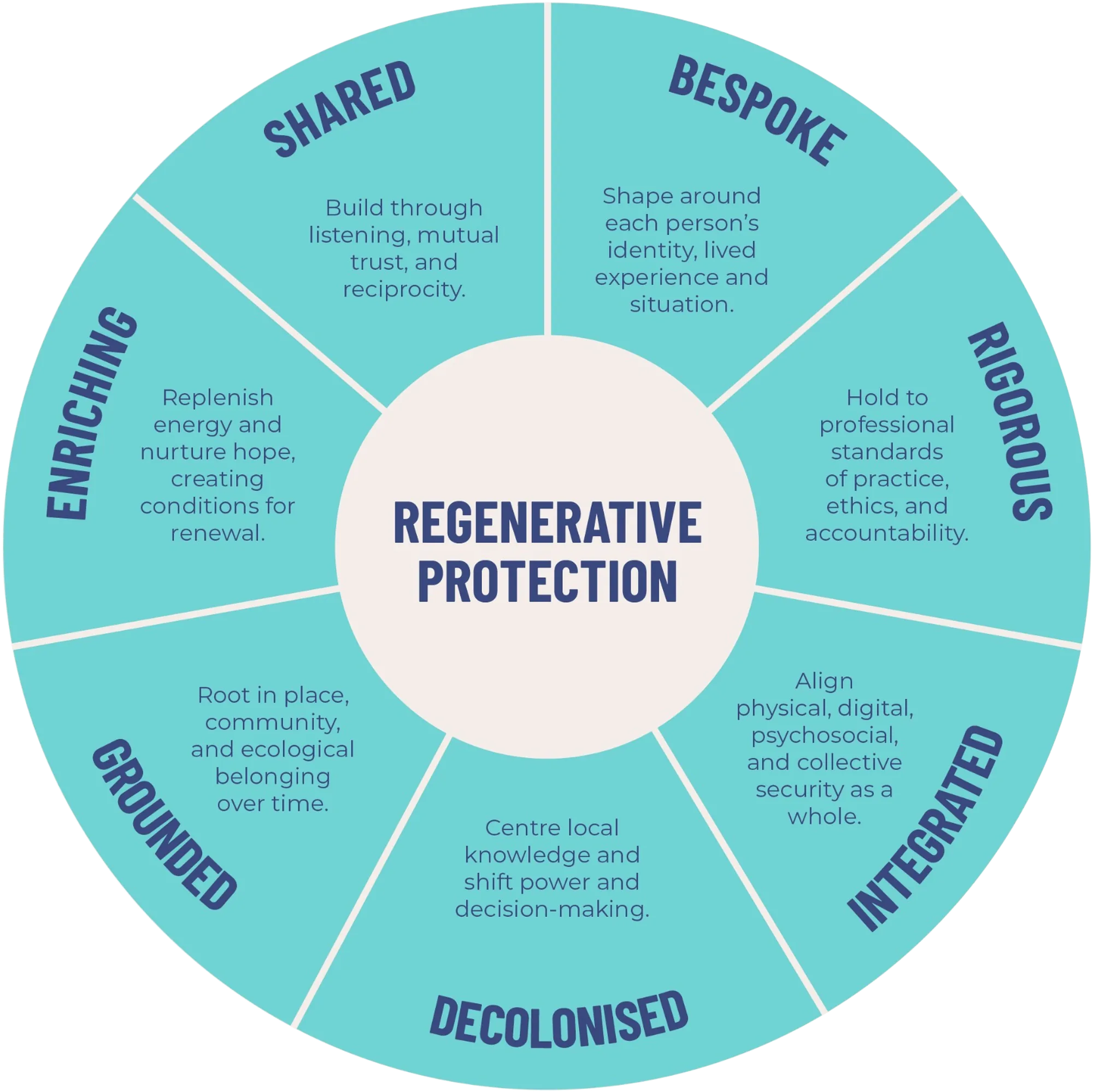
Protection is not something done to defenders. It is created with them. Those closest to the risks hold the deepest knowledge of their context. Our role is to support processes that place power, decision-making, and ownership with them.
At its heart, regenerative protection is about strengthening the people, structures, and relationships that make collective action possible. The measure of success is not simply survival. Defenders who are safe and supported remain connected to their communities, grow in confidence and capacity, and strengthen the people around them.
In this way, regenerative protection bridges the gap between individual resilience and collective renewal.
Where we will focus
Our new strategy is organised around three dimensions of change: movements, infrastructure, and conditions.
- First, we will continue to focus most of our effort directly alongside defenders, organisations, and movements advancing rights, justice, and accountability. This is the heart of our work. We will strengthen our rapid response and accompaniment work, expand support to communities and coalitions, deepen cohort-based and peer learning approaches, and increase in-person accompaniment where this helps remove barriers and deepen trust.
- Second, we will strengthen the infrastructure around movements: the organisations, networks, practitioners, funders, and support systems that help defenders navigate threats, attacks, and harassment. We will invest in partnerships, referral pathways, practitioner development, and stronger locally rooted protection ecosystems.
- Third, we will work to influence the conditions that shape whether civil society can act safely and effectively. In particular, we will use our position between frontline realities and philanthropic practice to make the case that protection and wellbeing are not optional extras. They are essential to impact.
These dimensions reinforce each other. Progress on conditions unlocks infrastructure work, and stronger infrastructure amplifies what movements can do.
How we will work
Across these dimensions, we will continue to work through five core approaches.
Through accompaniment, we will work alongside defenders and movements under threat, co-creating holistic security support so they can continue their work with greater safety, clarity, and confidence.
Through advisory, we will support nonprofits and foundations to understand and navigate complex risks, strengthen duty of care, and operate safely and effectively.
Through partnerships, we will work with protection organisations, funders, and allies to strengthen the ecosystem of support available to defenders.
Through convenings, we will help create spaces for practical advice, peer learning, shared reflection, and relationship-building.
Through knowledge, we will share tools, guidance, and insights drawn from our work alongside defenders to strengthen protection practice across the field.
These are not separate silos. They are different ways of putting regenerative protection into practice.
We will also pursue a focused set of strategic initiatives. Organised across Anchors, Programmes, and CoLabs, they strengthen protection ecosystems, deepen locally rooted support, remove barriers to access, and extend the reach and impact of our core work. Some will build on successful pilots and earlier experiments. Others will respond to new threats and opportunities as they emerge.
Our approach will remain adaptive. We will make choices based on need, opportunity, relationships, resources, and learning.
We deeply value our partnership with Open Briefing. Their holistic approach and unwavering support have been instrumental in our journey. Our collaboration is crucial for helping human rights defenders not only survive but thrive.
Exile Hub, Thailand
Scaling without losing what matters
We know demand for protection will continue to grow. But simply growing Open Briefing is not enough. Scaling primarily through direct delivery risks overstretching our team, weakening the relational approach that underpins our work, and limiting what others can lead.
So we will scale in three ways.
We will strengthen movements and communities to lead self-directed change. We will equip other organisations and networks to implement solutions. And we will build and support coalitions and alliances to advance shared goals.
This is how regenerative protection can extend beyond Open Briefing itself.
Our role is not to become the centre of the protection ecosystem. It is to help strengthen the human infrastructure that makes change possible.
What guides us
This strategy is grounded in our mission: Open Briefing builds protection and care with people and movements leading change under pressure.
It is also rooted in our values: be human, stay curious, share power, speak truth, and choose courage. These values matter because how we work is part of the change we seek.
Regenerative protection cannot be delivered through extractive, rushed, transactional, or externally imposed practice. It requires trust, rigour, humility, adaptation, and care. It requires us to hold professional standards while staying grounded in people’s realities. It requires us to build with others, not around them.
Our vision is a world where hope can become change. That is not a soft ambition. It is a radical one.
Hope becomes change when defenders can keep going. When movements have the support they need to endure. When protection is locally rooted, well-resourced, and shared. When funders understand that safeguarding defenders is safeguarding justice itself. When the people challenging unaccountable power are not left to carry the risks alone.
Partner with us
Demand for protection support consistently outpaces available resources. Delivering this strategy will require increased investment in flexible, longer-term funding that matches the sustained, relational nature of our work and its systemic impact.
We believe protecting and renewing the people leading change is one of the most effective investments philanthropy can make. We are building partnerships with foundations and donors who share this conviction. Together, we will ensure that hope can become change.
If you are a foundation or philanthropist interested in supporting our work, please contact our director of development, Vicky Nida, via info@openbriefing.org.