
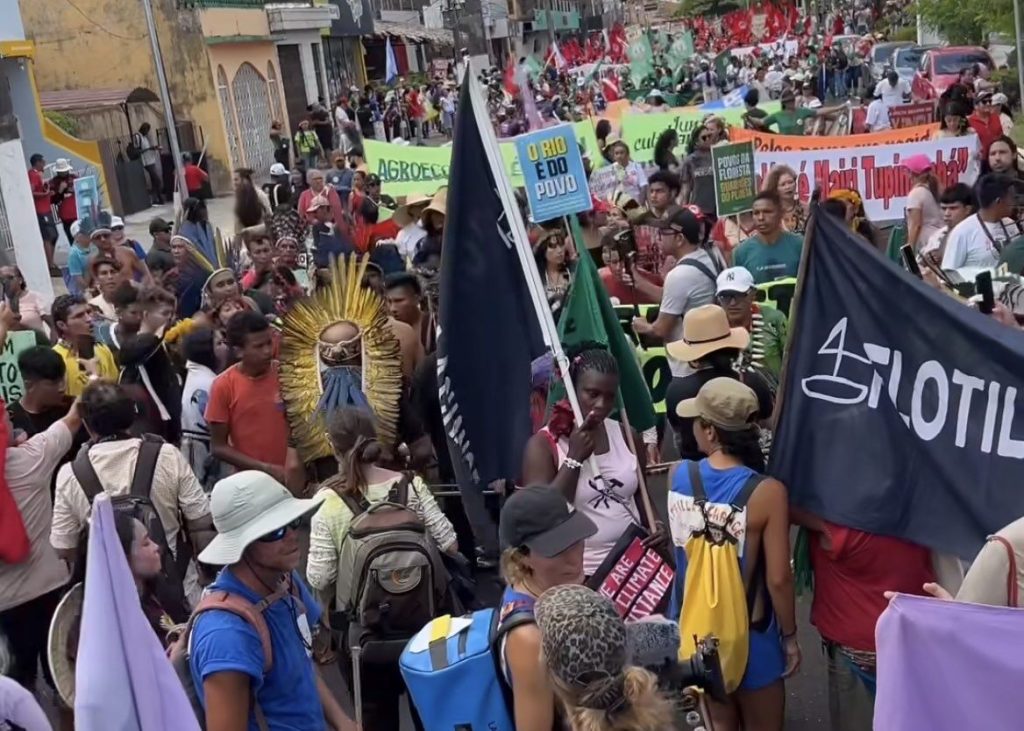
At COP do Povo – The People’s COP – in Belém, Brazil, Open Briefing supported activists, Indigenous leaders, and grassroots partners directly, strengthening collective protection, responding to emerging risks, and standing in solidarity with those most affected by climate injustice.
This reflection, co-authored by Renata Oliveira and Carla Vitória Barbosa, shares what they observed in Belém and why people-led spaces and collective protection matter for climate justice.
…
‘Our team was on the ground offering holistic security and safeguarding support’
Open Briefing’s presence in Belém was about working directly alongside environmental defenders, grassroots movements, and international partners to help participants stay safe, resilient, and able to participate fully in both official COP processes and people-led spaces. For the first time, our team was on the ground offering holistic security and safeguarding support throughout COP do Povo.
We were invited by Instituto Zé Cláudio e Maria and a coalition of Brazilian civil society organisations to contribute security advice, safeguarding training, and collective protection support. Over the two weeks, we delivered sessions on holistic security strategies and collective protection at Casa COP do Povo (the home of the People’s COP), bringing together NGO practitioners, lawyers, and human rights defenders from Cambodia, Bangladesh, Venezuela, Russia, and across Brazil. These spaces allowed us to explore practical approaches, share lived experiences, and build new connections across movements and regions. As Renata reflected, “Our presence is not just about offering protection advice; it’s about listening, learning, and co-creating security strategies that reflect the realities they’re faced with on the ground.”
In addition, Open Briefing supported the People’s Tribunal against Ecogenocide – a symbolic public hearing held on 13-14 November that brought national and international attention to the lived experiences of Indigenous, land, and environmental defenders. Although the Tribunal has no formal legal jurisdiction, it carries strong political and moral weight. A popular jury heard testimonies from affected communities and issued a final statement naming those responsible for environmental destruction, impunity, and corporate abuse. Because many witnesses were under threat or had experienced violence, Open Briefing’s on-the-ground support helped organisers and participants anticipate, prevent, and respond to associated risks.
‘This was the COP with the highest public participation in history’
When we arrived in Belém from Rio for COP30, we knew the city would feel different. But nothing prepared us for the energy that unfolded around us. Inside the official COP spaces, but also in the streets, cultural centres, community territories. Dozens of civil-society gatherings transformed the city into a living arena for people-led climate action.
This was the COP with the highest public participation in history. Beyond the Blue Zone – the official UN negotiation area – Belém hosted around 70 parallel spaces organised by social movements, Indigenous communities, cultural organisations, universities, and activists from across Brazil and beyond. The organising was so widespread and vibrant that it often felt as though the city itself had been reclaimed by civil society. It made us proud to be Brazilian.
And while the headlines naturally focused on diplomacy, agreements, and political negotiations, what was happening outside shifted how climate justice should be reclaimed and who are the main actors capable of upholding environmental protection. These reflections are personal and grounded in what we witnessed, learned, and felt during these extraordinary days in the capital of the Amazon.
‘Civil society was everywhere: visible, organised, unapologetic’
As we mapped the alternative spaces – cultural hubs, movement-led roundtables, grassroots assemblies – it was clear there was more happening than we could possibly take in during our two weeks in Belém. Civil society was everywhere: visible, organised, unapologetic. It made it impossible not to recognise this as a historic moment.
Hosting the world’s biggest climate conference in the largest city in the Amazon made contradictions impossible to ignore. Belém showed, in real time, the tension between global climate commitments and the lived realities of communities confronting deforestation, inequality, land grabs, and extractive industries every day.
Again and again, we were reminded that rural communities, forest peoples, riverside communities (Ribeirinhos), Quilombolas, and Indigenous nations are the main defenders of climate stability. Their protection is not optional. Without guaranteeing their safety and territories, there is no just transition.
On 17 November, Renata stepped away from the intensity of central Belém to visit Quilombo do Abacatal, an Afro-Brazilian community formed by descendants of enslaved people who resisted colonial violence and established autonomous territory over 300 years ago. Today, 170 families live there under matriarchal leadership that safeguards memory, culture, and land. Walking through a place where resistance has been lived for centuries reminded us that climate justice is inseparable from ancestral knowledge, community-led governance, and territorial rights.
‘Climate decisions are not elite negotiations but struggles rooted in everyday life’
While COP30 unfolded in heavily institutional and technical language, the civil society and social movements spaces, such as the Cúpula dos Povos, COP do Povo, Aldeia COP, and COP das Baixadas, felt alive, accessible, and grounded in experience. As this was Carla’s first COP, she checked in with more experienced partners to make sure she wasn’t simply overwhelmed by the scale of it. But everyone agreed: the visibility and unapologetic participation of traditional communities was extraordinary.
Over the week, Belém witnessed major mobilisations: the social movements’ march on 15 November and the Indigenous mobilisation on 17 November. Both reframed climate decisions not as elite negotiations but as struggles rooted in everyday life. Their pressure contributed to a major milestone: ten Indigenous lands were officially recognised by the Brazilian government during COP.
‘Living in harmony with nature is far more sustainable than the models defended by many states and corporations’
Aldeia COP, which we visited together, gathered more than 3,000 Indigenous people from across the world. Their slogan, “the answer is us,” captured something essential: that the practices of living in harmony with nature have persisted around centuries and offer alternatives far more sustainable than the models defended by many states and corporations.
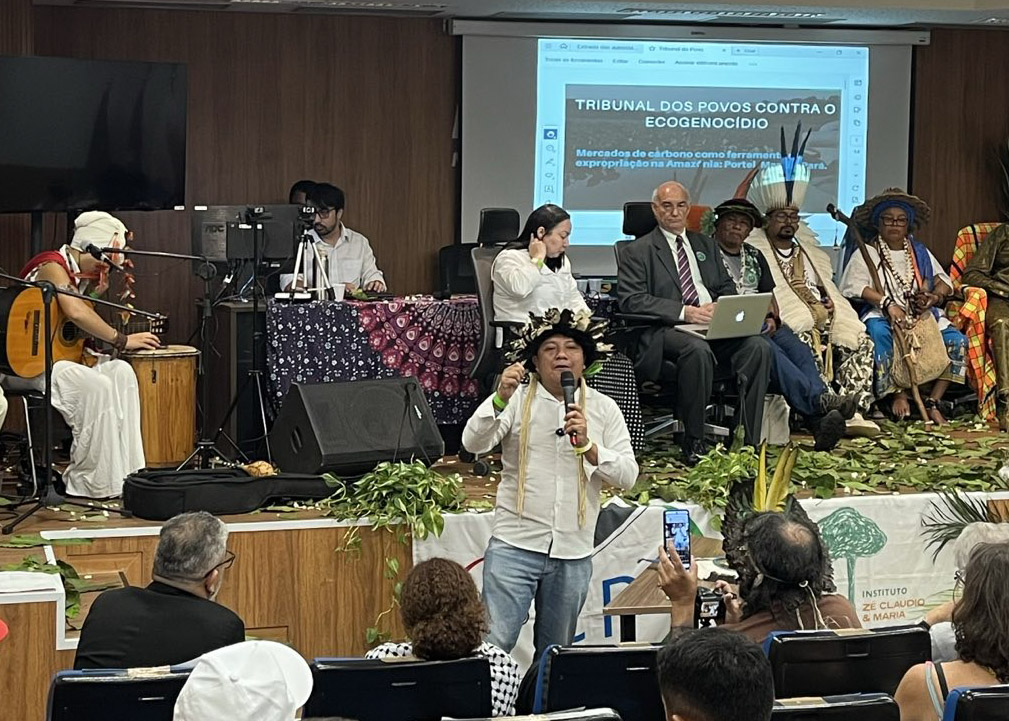
‘At the People’s Tribunal Against Ecogenocide community representatives publicly denounced the persecutions, threats, attacks, forced disappearance, and killings faced by defenders’
The Tribunal dos Povos contra o Ecogenocídio, or the People’s Tribunal Against Ecogenocide, was one of the most powerful spaces we experienced. Community representatives publicly denounced the persecutions, threats, attacks, forced disappearance, and killings faced by defenders. It serves as a mechanism of truth, accountability, and collective record-keeping. It sheds light on how violence against defenders and communities is a tool to silence them and enable land grabbing, mining, deforestation, and other profit-driven abuses.
‘Casa COP do Povo was a hub of movement, conversation, and connection’
Casa COP do Povo, the central gathering point of the People’s COP, became a constant hub of movement, conversation, and connection. There, and across Belém, we met dozens of civil society organisations through formal sessions, spontaneous gatherings, marches, and the mock trial.
We deepened relationships with long-standing partners, such as Not 1 More, CliDef, and Front Line Defenders, and reconnected with our partners from Global Witness, who played a central role in ensuring COP do Povo came to life. New collaborations also emerged organically, grounded in shared urgency and trust. It felt like the kind of relational organising that strengthens movements long after an event ends.
‘Holistic security is not a theory but a collective necessity’
Brazil, along with several other countries, continues to register some of the world’s highest rates of killings of land and environmental defenders. This context shaped every conversation we had, whether during side events or in community territories.
The mock trial held firm around those at greatest risk. Many defenders chose not to identify themselves publicly due to safety concerns, and this was respected entirely. Journalists were briefed, facilitators were cautious and thoughtful, and the space held firm around those at greatest risk.
Care spaces were offered in different civil society venues, from the dedicated wellbeing room at COP do Povo, Tenda de Cuidados at the Cúpula dos Povos, and the Aldeia COP. They were constantly used, reinforcing that holistic security is not a theory but a collective undertaking for the sustainability of life and rooted in the very own practices of the communities participating. We saw activists checking in on each other, sharing information about digital and physical risks, and rallying around those who suffered incidents or backlash during the week. This was solidarity in action.
‘Our role is to strengthen, not replace locally anchored protection’
Protection must be locally anchored. While Open Briefing brings international expertise in holistic security, the most effective and sustainable protection comes from the ecosystems already rooted in their communities. These actors understand shifting dynamics, local actors, and political nuance better than anyone. Our role is to reinforce, resource, and nurture these networks so their impact can deepen and endure.
Being in Belém also carried personal weight for our Brazilian on-the-ground team.
Renata said: “Being in Belém was especially meaningful for me – it was my first time back in Brazil after nearly a decade abroad, and experiencing such an intense moment of activism at home gave the whole week an emotional depth I didn’t expect. Sharing it with Carla made the experience feel incredibly grounding.”
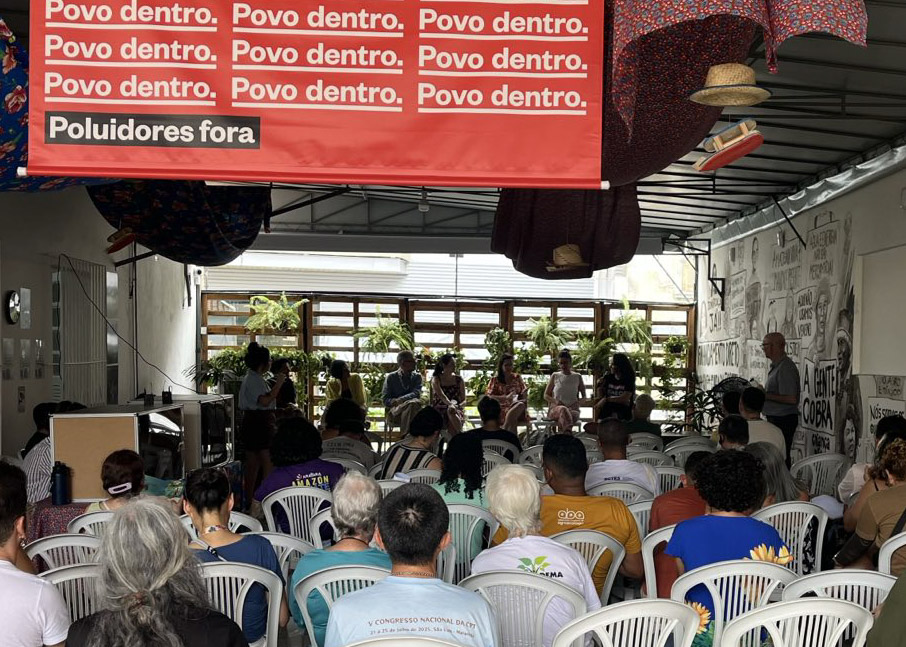
‘People-led spaces like COP do Povo are central to climate justice, and wellbeing must be integral to climate action’
Brazil’s civic space remains under profound pressure. Despite the mobilisation and global attention, Indigenous, land, and environmental defenders continue to face threats, criminalisation, and lethal violence. At the same time, the visibility of Indigenous leaders and traditional communities at COP30 created a rupture in the usual narrative. Seeing government officials and corporate actors walk through spaces filled with frontline communities cannot be easily forgotten.
For activists, funders, and partners, these reflections are a reminder that people-led spaces like COP do Povo are central to climate justice, that protection and wellbeing must be integral to climate action, and that solidarity across movements strengthens everyone’s safety and impact. Climate justice cannot exist without those living closest to the land, and without ensuring their protection, rights, and leadership. Belém made that clearer than ever.
…
Access further support and get involved
If you or your partners face threats related to your climate work, you can request fully-funded, rapid support through Open Briefing’s responsive assistance mechanism.
To access practical tools for analysing risk together and strengthening safety across teams, networks, and communities, you can download our Collective Protection guide. It’s available in English, Spanish, and Portuguese.
You can also explore other ways to work with us by reading our blog: ‘Five ways nonprofits can work with Open Briefing to stay safe and resilient’. If you’re a funder or philanthropist who believes in protecting the people who protect the planet, we’d love to hear from you. Contact our team at giving@openbriefing.org to discuss how you can join our incredible community of donors or read more about how Open Briefing works with foundations to strengthen civil society in our latest blog.